
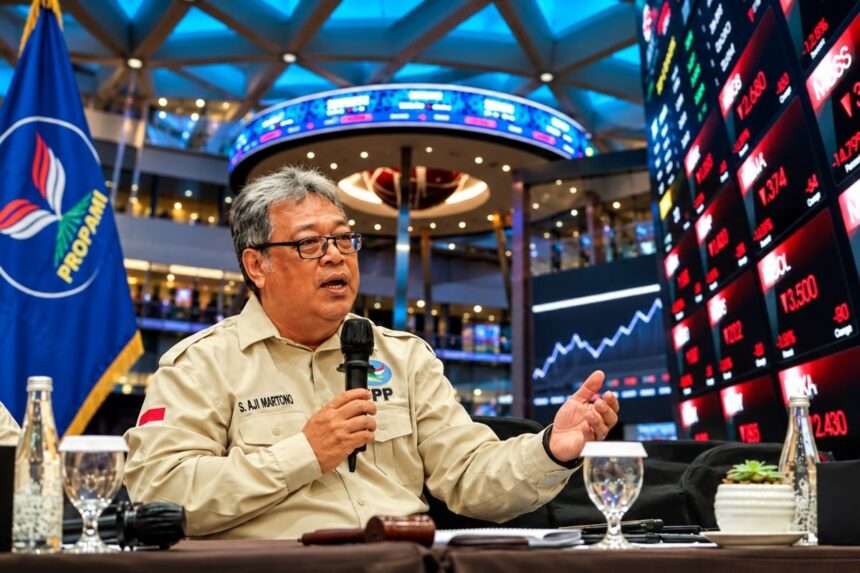
PROPAMI says reform delivery, not index-day panic, will determine whether investor confidence returns
IndonesiaBrief.com – Indonesia’s capital market professionals are urging investors to keep a sense of proportion after index provider MSCI floated a proposal that could strip the country of its Emerging Market status, a move that helped trigger a sharp sell-off on the Jakarta Composite Index (JCI) on Friday, jakarta (18/10/26).
The Indonesian Capital Market Professionals Association (PROPAMI) said the 16 October slide was a serious event that deserves the attention of every stakeholder, but should not be read as proof that the foundations of Indonesia’s market have lost their appeal. “Panic does not resolve structural problems,” the association said, adding that ignoring those problems “can prolong uncertainty.”
A proposal, not a final decision
On 15 October, MSCI launched a consultation on reclassifying Indonesia from Emerging Market to Standalone Market status, with a final decision due no later than the end of June 2027. PROPAMI stressed that nothing has yet changed Indonesia’s status, and that the consultation window gives both investors and authorities a chance to make their case.
The association was equally clear that the process should not be taken lightly. MSCI has flagged concerns over ownership transparency, shareholding concentration, suspected coordinated trading, and whether there is enough evidence that reforms are delivering lasting change. PROPAMI argued that answering those concerns defensively, without evidence, would do little to win back investors. Openness about where improvement is needed, it said, is a better starting point for rebuilding credibility.
One bad day is not a market verdict
PROPAMI cautioned against treating a single session’s index move as a judgment on the economy or on every listed company. Index classification uncertainty can prompt benchmark-tracking investors to rebalance, it noted, which can intensify price pressure, particularly in less liquid stocks. But companies differ widely in finances, ownership, valuation and outlook, and the impact will not be uniform.
The group also urged caution over headline estimates of potential capital outflows, describing them as projections built on specific assumptions rather than certainties. Actual flows, it said, will hinge on MSCI’s final ruling, investment mandates, the behaviour of active and passive funds, and market conditions at the time of any implementation.
Regulators’ reform pledge under scrutiny
PROPAMI welcomed a commitment by the Financial Services Authority (OJK), which said in a 16 October statement that it would follow up on MSCI’s feedback, strengthen market integrity and maintain dialogue with global index providers and institutional investors.
Reform initiatives announced so far include disclosure of shareholdings above 1%, more granular investor classification, disclosure of high shareholding concentration, and a roadmap to raise minimum free-float requirements.
The association called these a relevant foundation but said they will be judged on execution. Investors, it said, need proof that ownership data can be verified, that shares counted as free float are genuinely available for trading, and that suspected violations are met with consistent supervision and enforcement. It called on OJK, the Indonesia Stock Exchange (IDX), the Indonesian Central Securities Depository (KSEI) and other stakeholders to set clear milestones, measurable success indicators and regular progress updates. It also backed the IDX’s efforts to seek clarification from MSCI on the issues that remain unresolved, including disclosure standards, measurement methodologies and the evidence needed to assess progress.
Fundamentals still matter, but are no guarantee
OJK has said the domestic market retains prospects, citing economic fundamentals, a growing investor base, competitive valuations and generally positive issuer fundamentals. PROPAMI treated that as a basis for evaluation rather than a promise of a near-term rebound, noting that strong fundamentals do not eliminate governance, liquidity, currency or global allocation risks. Investors, it said, should separate systemic risks from company-specific ones, judging issuers with solid financials, healthy cash flow and sound governance on their own merits without ignoring the wider backdrop.
The association also framed transparency as more than a foreign-investor demand. It is, PROPAMI said, essential for domestic savers and investors as well.
Advice to investors and the industry
PROPAMI urged investors to base decisions on official information, fundamental analysis, liquidity, investment horizon and personal risk tolerance, rather than on headlines, rumours or unconfirmed flow estimates. It advised reviewing issuer disclosures, understanding portfolio concentration, and avoiding borrowing or trading facilities beyond financial capacity during volatile periods.
That does not mean holding every position, the association said; it means avoiding impulsive moves made without understanding one’s exposure. It also called on brokerages, fund managers, analysts and other professionals to communicate risks transparently, refrain from spreading unverified information and put clients’ interests first.
A window to act
Rebuilding confidence, PROPAMI said, will take a joint effort: consistent enforcement and disclosure from regulators, better data quality and surveillance from the exchange and market infrastructure, stronger governance from issuers, and integrity and competence from market professionals. The association said it stands ready to support professional standards, ethics and responsible investor education.
“Confidence is not built by denying problems,” PROPAMI said, “but by demonstrating that each problem is addressed seriously, fairly, and measurably.” With the MSCI consultation still open, it added, the opportunity to show verifiable progress must be used for substantive action “not merely optimistic statements.”
Its message to the market: remain calm, remain critical, and remain rational. The credibility of Indonesia’s capital market, it concluded, will depend on turning today’s pressure into meaningful, transparent and sustainable reform.